I recently stumbled across an old article I was interviewed for years ago about one of the bigger infrastructure decisions I was involved in early in my career.
I hadn’t read it in a long time, so of course I clicked on it.
Reading it again made me think about how much has changed since then. Nutanix has changed. VMware has changed. The way we buy technology has changed. And I definitely look at infrastructure decisions differently today than I did as a systems administrator thirteen years ago.
Some of the things I said back then aged pretty well. A few made me laugh.
But one thing hasn’t changed: I still believe in Nutanix.
So I figured it was probably time for a follow-up.
Taking a Chance on Something Different
Back around 2013–2014, we needed a major infrastructure refresh. The traditional answer was pretty straightforward: more servers, another SAN, and basically more of what we already had.
We priced out a Dell server and EqualLogic SAN solution at around $200,000.
And yes, that was $200,000 in 2013–2014 money — before inflation, AI, and seemingly everything else decided to drive technology costs through the roof. 😂
Then we looked at Nutanix.
At the time, hyperconverged infrastructure wasn’t the obvious choice it later became. Nutanix was still a relatively young company, and choosing HCI instead of the traditional server-and-SAN model meant being willing to take a different path.
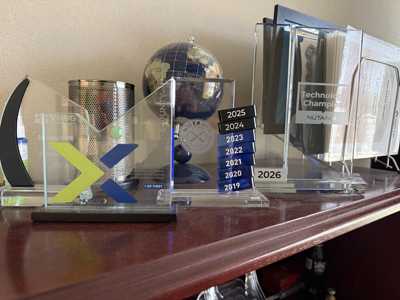
We were early enough that we ended up being one of Nutanix’s first 5,000 customers. They actually sent me an award recognizing it, and I still have it today.

The numbers were hard to ignore. We were able to get roughly three times the compute and storage for less than one-third of what we were considering spending on the traditional architecture.
So we took the chance.
And it worked.
Seeing What Something Could Become
One thing I talked about in that original interview was the influence Steve Jobs had on the way I think about technology.
That is still true.
What I always admired about Jobs wasn’t just that he thought differently. It was his ability to look at something as it existed today, see what it could become tomorrow, and then turn that possibility into something real.
I’ve tried to carry some of that mindset into my own work. Not being different just for the sake of being different, but being willing to question the default answer.
Instead of asking, “What do we normally buy?” ask, “What could this look like if we built it around what we actually need?”
Some of the best technology decisions I’ve been part of started with that second question.
One Cluster Became Three
That first Nutanix deployment eventually grew into three clusters, including production and disaster-recovery infrastructure.
As the environment grew, Prism Central became one of the things I appreciated most. When it came along, it was a breath of fresh air.
Being able to manage multiple clusters through a single pane of glass sounds fairly normal today. Back then, coming from an infrastructure world where servers, storage, virtualization, and management all tended to have their own interfaces, it was a big change.
It taught me something I still think about today: Adding technology is easy. Managing the complexity you create afterward is the hard part.
We Still Ran VMware
Here’s an important part of the story: we ran VMware on top of Nutanix.
I believed in Nutanix, but I also believed VMware was the right hypervisor for us at the time. VMware was mature, proven, and supported by practically everyone.
That last part mattered.
One of AHV’s early challenges wasn’t simply whether the hypervisor worked. It was the ecosystem around it. A lot of enterprise products came as virtual appliances built, tested, and officially supported on VMware.
Could you sometimes get those appliances running somewhere else? Sure.
But there’s a huge difference between “I got it to work” and “the vendor will support this when production is down at 2:00 in the morning.”
If you’ve operated production infrastructure, you know why that matters.
Technology decisions aren’t just feature comparisons. Supportability matters. Compatibility matters. Migration risk matters. The people who have to operate it matter. The economics matter.
Back then, VMware won that evaluation. And I still believe it was the right decision.
AHV Grew Up
But Nutanix kept investing in AHV. And AHV grew up.
The platform matured. Vendor support improved. Migration tooling improved. Networking and security improved. The ecosystem expanded.
If you had asked me years ago whether I would replace VMware with AHV, I would have said no.
Today? AHV absolutely gets a seat at the table.
That doesn’t mean it automatically wins. Nothing should automatically win.
The right answer depends on the applications, workloads, team, budget, risk tolerance, and what the organization is actually trying to accomplish.
But today I absolutely consider AHV a legitimate enterprise hypervisor and a serious VMware competitor.
You can’t evaluate today’s technology based on what you remember it being ten years ago.
I Never Really Left Nutanix
For roughly six years, Nutanix hasn’t been something I’ve administered every day.
But I never really stopped following it.
I stayed involved with the community, watched the technology evolve, and in 2026 I’m still a Nutanix Technology Champion.
I’m proud of that.
My opinion of Nutanix isn’t based on whatever product happens to be sitting in front of me today. It’s based on having evaluated it, implemented it, operated it, expanded it, and lived with the decision afterward.
Buying technology is one thing. Living with what you bought is another.
A Comment I Never Forgot
At one point along the way, I heard Nutanix referred to as a “little boy toy,” with the suggestion that serious enterprise IT meant playing with the “big boy toys.”
I never forgot it — not because of who said it, but because of the mindset behind it.
Sometimes in IT we confuse familiar with better, or more expensive with more enterprise.
I’ve learned to care much more about whether a solution actually solves the problem, whether it can scale, whether the team can operate it, whether the vendor will support it, and whether the economics make sense.
Then Broadcom Bought VMware
Broadcom’s acquisition of VMware changed the virtualization conversation.
VMware didn’t suddenly become bad technology. It didn’t.
I used VMware. I trusted VMware. I chose VMware.
There are still organizations where VMware will absolutely be the right answer. But the business side changed dramatically.
Licensing changed. Packaging changed. Bundles changed. VMware itself documented the shift away from perpetual licensing and the consolidation of its portfolio into subscription offerings.
At the same time, some customers and partners reported renewal increases several times higher than what they had historically been paying. CRN reported analysts seeing examples ranging from roughly 3x to 8x to 10x, while other industry reporting described similar experiences.
At some point, even a customer who loves the technology has to ask: “What else is out there?”
For years, VMware often didn’t have to win that conversation. VMware was the conversation.
That’s changing.
Broadcom Made the Opening. Nutanix Kicked the Door Wide Open.
Broadcom made the opening. Nutanix kicked the door wide open.
And Nutanix was ready because it had already spent years doing the work.
AHV matured. Prism matured. Migration tooling matured. Vendor support improved. The ecosystem grew.
So when VMware customers started evaluating alternatives, Nutanix didn’t have to promise that someday it would have something ready.
The alternative was already there.
That doesn’t mean VMware is disappearing. It isn’t.
For some organizations, staying with VMware will continue to make the most technical and business sense. But now there’s a real evaluation again.
And competition is good.
What Thirteen Years Changed for Me
Thirteen years ago, I looked at most infrastructure decisions through the eyes of a systems administrator.
I still care about the architecture today. But the questions I ask have gotten broader.
- What’s the real problem we’re trying to solve?
- What’s the long-term cost?
- Can the team support it?
- What’s the migration path?
- What’s the risk?
- What happens if the vendor changes direction, gets acquired, or completely changes its business model?
- What’s the exit strategy?
And probably the biggest question: Are we choosing this because it’s actually the best answer, or because it’s the answer we’re most comfortable with?
Sometimes the incumbent wins. But it should have to earn the win.
Years on the customer side of the table have also taught me that the technically coolest solution isn’t always the right solution.
A demo can look amazing and still be completely wrong for the organization buying it.
You have to understand the environment. The people. The risks. The budget. What they’re trying to accomplish. And what they’re worried could go wrong.
That’s where good architecture decisions actually get made.
Looking Back
In that original interview, I said: “Having a clear vision is crucial to innovation.”
I still believe that. Probably more now than I did then.
But experience has added a few things.
Vision requires curiosity. It requires conviction. It requires being able to see what’s possible. And it requires enough humility to change your mind when the facts change.
Years ago, I believed VMware was the right hypervisor to run on Nutanix. At that point in time, I believe it was.
Today, I would evaluate that decision differently.
That’s not inconsistency. That’s what we’re supposed to do in technology.
Make the best decision with the facts in front of us, then be willing to reevaluate when those facts change.
I’m glad we took that chance all those years ago.
One cluster became three. Prism changed what I expected infrastructure management to look like. AHV went from something I wasn’t willing to trust for production workloads to something I now consider a legitimate VMware competitor.
And after all these years, I’m still part of the Nutanix community and still believe in the platform.
Broadcom made the opening. Nutanix kicked the door wide open.
But the biggest lesson for me isn’t really about Nutanix or VMware.
It’s that the best technology decisions happen when you understand the architecture, understand the business, understand the people who have to live with the decision — and you’re willing to challenge the default answer when you believe there’s a better path.
Read the original customer story that started this retrospective.
 John A. Hamilton
Leave a comment