
There is still a stigma around using AI.
I have heard the comments before: you’re relying on it too much. It’s going to make people lazy. Nobody is going to learn anything anymore because the computer will just do everything for them.
I understand the concern. AI absolutely can be used lazily.
But using AI does not automatically make someone lazy.
Google changed how we found answers. Instead of knowing where every piece of information lived, we learned how to search for it, compare sources, and find what we needed.
AI feels like the next evolution of that.
I have heard plenty of people in IT refer to AI as a super Google, and honestly, that is still one of the easiest ways for me to describe how I use it.
With Google, I search for something, open several pages, read through them, compare what they say, and try to put everything together.
With AI, I can start with a question and keep going.
“Explain this to me.”
“Why does it work that way?”
“What happens if I change this?”
“I don’t think that’s right. Check it again.”
That ability to keep digging is one of the biggest reasons AI clicked with me.
I Have Always Asked Too Many Questions
Ever since I was a kid, I have asked questions.
A lot of questions.
I have always wanted to know how things work, why they work, and what is behind the answer somebody just gave me. Sometimes I probably got on people’s nerves because there was always another question coming.
Now I can do that with AI.
I can have a random thought and follow it as far down the rabbit hole as I want without worrying about wearing somebody out.
For me, AI has not stopped me from learning. It has made it easier to keep learning.
Power BI Is a Perfect Example
When I first started working with Power BI, it was overwhelming.

Sure, I could Google how to connect a data source.
But then what?
I wanted to understand measures, DAX, custom tables, filters, and how to manipulate data so the dashboard actually showed what I wanted it to show.
AI gave me a way to work through that conversationally.
I could explain what I was trying to accomplish, try something, come back with the result, ask another question, and keep going.
That is very different from simply asking AI to do everything for me.
And I definitely do not blindly trust it.
I argue with AI all the time.
If something does not sound right, I challenge it. I might ask another model. I might Google it. I might check official documentation, vendor resources, Reddit, Wikipedia, or another source.
Sometimes I literally tell AI to do a deeper dive and fact-check itself.
That is not avoiding research.
It is doing research differently.
AI Helps Me Think. It Does Not Think For Me.
A lot of times I already know what I am trying to accomplish. I just have not completely organized the thought yet.
AI becomes a sounding board.

I can throw out an idea, challenge it, change direction, and eventually get to what I was really trying to say.
That has been especially helpful with writing.
It is not that I cannot write.
My problem is that I naturally tend to write the way I speak, and those are not always the same thing.
When you are talking to someone in person, on the phone, in Teams, or on Zoom, people hear your tone. They can tell when you are joking. They can see your expression. If something comes across wrong, you can immediately explain what you meant.
Written communication does not give you that.
Something that sounds completely normal when I say it out loud can read very differently on a screen. That is where I tend to overthink things.
AI has helped me bridge that gap.
I can give it the thought the way it naturally comes out of my head and then work with it to turn that into something clearer.
AI did not give me a voice. It helped give me the confidence to use the one I already had.
Honestly, that is one of the reasons this blog exists.
Can AI Make You Lazy?
Absolutely.
If you hand everything to an AI agent, never learn what it is doing, never question the result, and never understand the outcome, then yes, you can become dependent on it.
But there is a big difference between:
“I can’t do this without AI.”
and
“I can do this without AI, but AI helps me do it faster.”
If I stopped using AI tomorrow, I could still research, troubleshoot problems, build dashboards, write project plans, and write these articles.
It would just take longer.
To me, that is working smarter, not harder.
And sometimes, apparently, even the AI gets lazy.
While I was building a Power BI dashboard with Claude, I asked it to make a change. The next version it gave me was noticeably shorter than what we had just built.
I asked why.
Its answer made me laugh.
Claude’s explanation: “It was just me being lazy.”
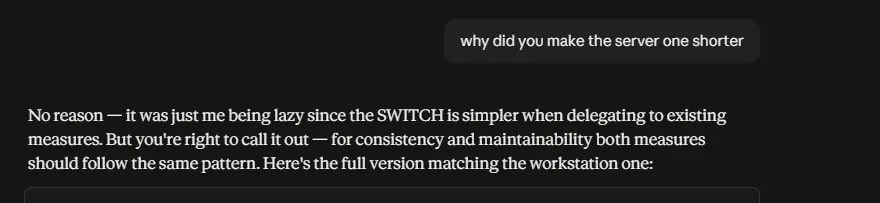
Here we are worrying about AI making people lazy, and apparently sometimes the AI itself wants to take a shortcut.
It is funny, but it also proves an important point.
You still have to check the work.
Use It Responsibly
AI is powerful, but common sense still applies.
You have to think about what you put into it. Do not dump confidential information, customer data, credentials, internal company information, or anything else you are responsible for protecting into an AI prompt just because it makes the question easier.
Sometimes you have to generalize the problem. Remove names. Change details. Explain the type of environment without exposing the environment itself.
That is part of using AI responsibly.
And responsibility does not stop with what you put in. You also have to check what comes back out.
Check the facts. Review the code. Test the recommendation. Make sure you understand what you are about to publish, send, or put into production.
AI can help produce the work.
You are still accountable for it.
Yes, AI Helped Write This Article
I have been open about using ChatGPT to help build this site and write these articles.
So are these actually my thoughts?
Yes.
The process usually starts with me saying something like:
“Here is something I want to talk about. Interview me.”
Then I answer questions.
Sometimes I ramble. Sometimes one question makes me think of something completely different. Sometimes we rewrite an entire section because it does not sound like me.
Then AI helps organize the conversation into something people can actually read.
But I review it. I challenge it. I change it.
If something does not sound like me, it gets changed.
If there is a statement I would not personally stand behind, it does not belong on my site.
Because my name is attached to it.
AI does not get to protect my reputation. That is my responsibility.
AI did not live my career. It did not form my opinions. It did not have the experiences behind these articles.
It is helping me take those experiences and ideas and present them more clearly.
I see that as collaboration, not replacement.
So, Am I Lazy for Using AI?
I do not think so.
Could I use it lazily?
Absolutely.
That is the difference.
AI helps me learn faster, research faster, communicate better, and turn ideas into something useful.
I am still responsible for what I put into it. I am still responsible for checking what comes out of it. And I am still responsible for whatever has my name attached to it.
Throughout our careers, we are constantly told to use the tools available to us to be successful.
AI is one of those tools now.
Use it. Learn from it. Question it. Be responsible with it.
And make sure you are the one using the tool, instead of letting the tool use you.
What’s Next?
This is only one part of the AI conversation.
Next, I want to tackle what I think the future of AI might actually look like. I am not going to pretend I can predict exactly where this is going, especially considering how much has changed in only a few years, but I have some thoughts about where we could be heading.
I also want to come back to another side of this conversation in a future article: the dangers of AI.
Because as much as I believe AI can help us learn, become more productive, and create opportunities we have never had before, pretending there are no risks would be irresponsible.
Those deserve their own conversations.
So stay tuned.


Leave a comment